basal-omni-2.0-mini (preview): two-way reading and 0.811 on Werdykt
An early release of the small model of basal-omni 2.0, on Gemma 4 E4B. The model reads the state in both directions before it answers and scores 0.811 on Werdykt (5,000 hidden decisions in Polish and English). It runs on the public basal engine 2.8.0, with the same API as basal-omni-1.0. The final basal-omni 2.0 comes later, together with the whole family: nano, mini, max and ultra.
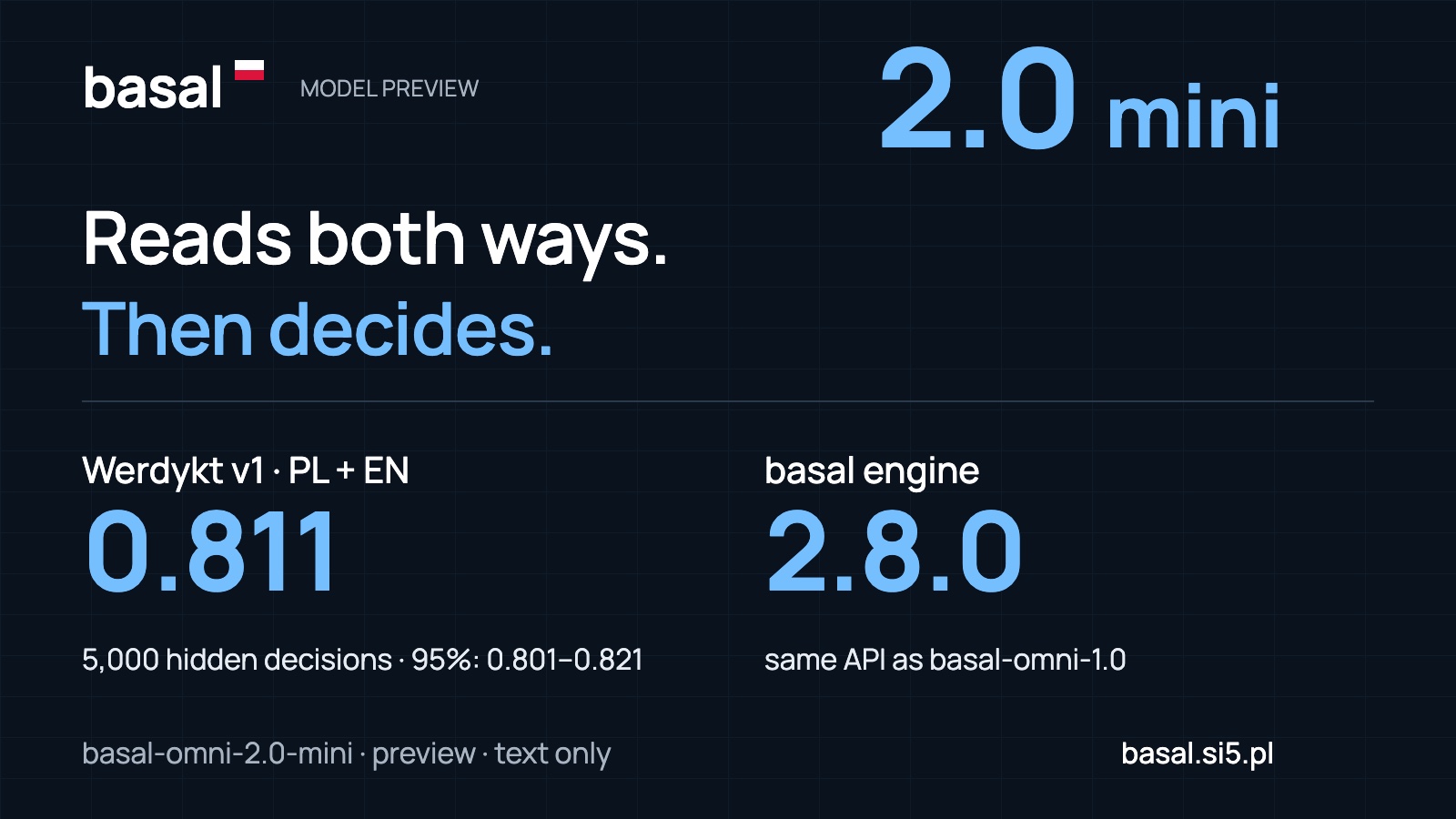
basal-omni-2.0-mini (preview) is an early release of the small model of basal-omni 2.0, on Google Gemma 4 E4B. The model does not write an answer. It reads a state (a message, a document, retrieved passages, an agent trace or a web page as JSON) and answers a typed question about it. For each allowed answer it returns a calibrated probability.
Every number in this post comes from the model card and applies to this preview only. We measured Werdykt with basal engine 2.5 in --mode fast, with one option order.
What the 2.0 mini preview is
We will release the final basal-omni 2.0 later, together with the whole family: nano, mini, max and ultra. This preview lets you try the 2.0 mini now. The final mini may differ from it.
We fine-tuned it from Google Gemma 4 E4B on Polish and English typed decisions. The weights are Apache-2.0, like the base model. The Hugging Face repository is Remek/basal-omni-2.0-mini-preview.
The preview is served by the public basal engine 2.8.0, with the same API as basal-omni-1.0: the same typed questions and the same endpoint POST /v1/systemone. It is a text model: we trained and evaluated it on text only.
What's new in 2.0
- Two-way reading. The model reads the state in both directions before it answers. This needs basal engine 2.5 or later. For long prompts, see the limitations.
- Higher accuracy on our hidden Polish and English decision benchmark Werdykt and on the held-out tests below.
- More decisions automated at a given error target. Coverage is in the section on confidence.
- Unchanged: a calibrated probability for each allowed answer, in one forward pass. The answer never falls outside the options you give, and the probability says how sure the model is.
The question types remain: choice (one option), noul (yes / no), score (a score), and in the basal engine also multi, act and tool. Options get codes (A–Z, then two-character codes, up to 255 options). The decision is a probability distribution over these codes only, with no text generation.
Results
Werdykt is our hidden benchmark: 5,000 decisions in Polish and English across 10 categories. The macro score gives each of the 20 groups (category × language) the same weight. The other rows are held-out tests.
| Test | Result |
|---|---|
| Werdykt v1, macro (hidden, PL + EN, 10 categories × 2 languages, 5,000 items) | 0.811 (95% interval 0.801–0.821) |
| Werdykt v1, Polish / English | 0.807 / 0.814 |
| PL decisions (held-out test, 7,081 items) | 0.951 |
| PL general (knowledge, exams, reading; 3,079 items) | 0.767 |
| PL-Real (300 real Polish documents) | 0.960 |
| EN external panel (10 public English decision tasks, 3,842 items) | 0.811 |
| EN corpus test (1,479 items) | 0.692 |
Held-out tests: the public basal engine 2.8.0 and the released files, one NVIDIA H100, --mode eager, bf16, one option order (the default), the shipped CALIBRATION.json. Werdykt: basal engine 2.5, --mode fast, one option order, one NVIDIA RTX PRO 6000 Blackwell (bf16). The public engine 2.8.0 gives the same probabilities on our parity set (largest difference 5 × 10⁻⁶).
English panel covers ten public tasks. In the panel score each task counts the same, whatever its number of items.
| Task | Questions | Result |
|---|---|---|
| FinancialPhraseBank | 300 | 0.957 |
| Belebele (English) | 300 | 0.940 |
| WinoGrande | 300 | 0.907 |
| Circa | 300 | 0.837 |
| TabFact | 300 | 0.830 |
| BIG-Bench Hard | 540 | 0.811 |
| RAGTruth | 300 | 0.780 |
| ContractNLI | 300 | 0.777 |
| TruthfulQA (binary) | 902 | 0.649 |
| JudgeBench | 300 | 0.627 |
| English panel (each task counts the same) | 3,842 | 0.811 |
The weakest Werdykt categories are rules (0.382), long documents (0.694) and contracts (0.726). Rules need exact thresholds and dates; compute those in code. The strongest categories are retrieval (0.982), real documents (0.978) and routing (0.966).
Comparison on Werdykt
Five other decision models took the same test: the strongest 4B-class models we checked, and the Polish Bielik-One in its 4B and 11B versions. This is a selection of models, not a full ranking.
| Model | Class | PL + EN ↑ (95% interval) | PL / EN | Preview's lead, points (95%) |
|---|---|---|---|---|
| basal-omni-2.0-mini (preview) | 4B (E4B) | 0.811 (0.801–0.821) | 0.807 / 0.814 | – |
| torchcast-decision-4b v1.3 | 4B | 0.799 (0.788–0.809) | 0.787 / 0.810 | +1.22 (+0.14 to +2.24) |
| KnowLine-4B-Gen5.5 (FP8) | 4B | 0.776 (0.766–0.787) | 0.764 / 0.788 | +3.44 (+2.30 to +4.50) |
| H2O-Lightning-4B v1.1 | 4B | 0.753 (0.742–0.764) | 0.745 / 0.761 | +5.78 (+4.70 to +6.92) |
| Bielik-One-11B-v3.1-r1-Adapter | 11B | 0.703 (0.691–0.714) | 0.708 / 0.698 | +10.82 (+9.58 to +12.04) |
| Bielik-One-4B-r1 | 4B | 0.696 (0.684–0.709) | 0.687 / 0.705 | +11.46 (+10.22 to +12.64) |
Werdykt v1: the same 5,000 hidden items (PL + EN) and the same client (16 concurrent requests, option keys hidden), through each model's typed decision API (/v1/systemone). Each model runs on the server its maker recommends; the protocol and the items are the same. KnowLine-4B-Gen5.5 ran in FP8, the other models in bf16. The set is hidden and has no public items, so only aggregates are shown. Macro score: each of the 20 groups (category × language) counts the same. The lead is a paired bootstrap over the same 5,000 items. Read 8 October – 13 November 2026: the preview on basal engine 2.5 (--mode fast, one option order), H2O-Lightning-4B v1.1 on an H100 (the same value as on the public board), the others on an RTX PRO 6000. Revisions: torchcast-ai/torchcast-decision-4b @492bfb19, PelaAI/KnowLine-4B-Gen5.5 @779944d2, speakleash/Bielik-One-11B-v3.1-r1-Adapter @aab0a71f, speakleash/Bielik-One-4B-r1 @a5a17dad.
The preview is ahead of each of these models, and in every pair the 95% interval of the lead excludes zero. The closest is torchcast-decision-4b: 1.22 points apart. Over Bielik-One 11B and 4B the lead is 10.82 and 11.46 points.
Accuracy by document length
This is accuracy on Werdykt (5,000 items, Polish and English) by the length of the state, in characters. A token is about 2 characters, and 1,000 characters is about half a page. Overall: 81.1%. The set is hidden, so only these totals are shown.
| State length (characters) | Questions | Accuracy | 95% interval |
|---|---|---|---|
| 0–1k | 709 | 71.4% | 68–75% |
| 1k–2k | 2,598 | 80.0% | 78–82% |
| 2k–4k | 796 | 92.3% | 90–94% |
| 4k–8k | 394 | 97.5% | 95–99% |
| 8k–16k | 128 | 80.5% | 73–86% |
| 16k+ | 375 | 65.9% | 61–70% |
Short states are mostly rules items and items where the right answer is to abstain. These are harder tasks, so read the rows as accuracy per bucket, not as the effect of length alone. The long-document family keeps the task and varies only the length:
| State length (characters) | Questions | Accuracy | 95% interval |
|---|---|---|---|
| 8k–20k | 226 | 74.3% | 68–80% |
| 20k–30k | 194 | 70.1% | 63–76% |
| 30k+ | 80 | 53.8% | 43–64% |
Same run as the Werdykt score above. The Wilson intervals are about the number of items, not about run-to-run noise.
In the long-document family, accuracy falls as length grows, most of all above 30k characters. If your documents are that long, test the model on your own examples.
Confidence and automation
In the model repository, the file CALIBRATION.json holds a temperature for each question type and certified confidence thresholds for a target of 1% or 5% error among accepted decisions. We chose the thresholds on calibration data before testing, on the engine that serves the model (--mode eager, bf16, one option order). Accept decisions above the threshold automatically and route the rest to a person.
| Error target | Coverage | Observed error |
|---|---|---|
| 1% | 58.3% | 0.58% |
| 5% | 87.8% | 4.0% |
Held-out tests: PL decisions and the EN corpus test, 8,560 decisions in total, with the per-type thresholds of the shipped CALIBRATION.json, as the server applies them.
At the 1% target, score questions have no certified threshold and go to a person. Per type: choice 78.2% at 0.74% error, yes / no 43.8% at 0.15% error. At the 5% target: choice 94.7%, yes / no 88.0%, score 47.6%.
For --orders 2, which asks in both option orders, the model has its own file CALIBRATION.o2.json.
Speed
| Measurement | --mode fast |
--mode eager |
|---|---|---|
| Sequential, 200 requests: p50 / p95 per question | 11 ms / 17 ms | 54 ms / 73 ms |
| 32 concurrent clients, 1,000 requests | 123.5 decisions/s | 59.7 decisions/s |
| Sequential, states of 4,000–5,000 tokens: p50 per question | 98 ms | 212 ms |
| 16 questions about one state in one request, 8 concurrent | 200 decisions/s | 94 decisions/s |
The first three rows ask one question per request. fast is the default on Hopper GPUs with FlashAttention 3; eager was measured with --media on. GPU memory while serving: 20.6 GB (fast), 31.7 GB (eager, --media on). --orders 2 costs about twice as much per question.
Speed next to other models
We also measured speed in the same Werdykt runs. The chart shows the five models from the comparison table that ran on the same GPU.
Throughput and time per decision
Two separate measurements on Werdykt v1's long states, on one NVIDIA RTX PRO 6000 Blackwell Max-Q. Higher is better in the first panel, lower is better in the second.
| Model | Decisions/s, 16 clients | Median, ms | p95, ms |
|---|---|---|---|
| basal-omni-2.0-mini (preview) · 4B · bf16 | 15.0 | 27 | 366 |
| torchcast-decision-4b v1.3 · 4B · bf16 | 12.2 | 43 | 376 |
| KnowLine-4B-Gen5.5 · 4B · FP8 | 19.3 | 53 | 223 |
| Bielik-One-11B-v3.1-r1-Adapter · 11B · bf16 | 4.6 | 104 | 1,128 |
| Bielik-One-4B-r1 · 4B · bf16 | 15.7 | 79 | 353 |
With one request at a time the preview has the shortest time of these five: a median of 27 ms per decision. In throughput with 16 clients it is mid-pack: 15.0 decisions/s, while KnowLine-4B-Gen5.5 in FP8 (19.3) and Bielik-One-4B-r1 (15.7) handle more. The preview's p95 time, 366 ms, is close to torchcast-decision-4b and Bielik-One-4B-r1; KnowLine-4B-Gen5.5 has the shortest (223 ms).
Why the two panels differ. One request at a time, the preview answers fastest (median 27 ms). With 16 concurrent clients it gains little: 0.9× its one-at-a-time rate, against 1.7× for Bielik-One-4B-r1 and 1.4× for torchcast-decision-4b and KnowLine-4B-Gen5.5. Two-way reading turns off the engine's prefix and state caches, which is where batching pays off. Few clients: clearly faster. Many clients on long documents: mid-pack.
Measurement: Werdykt v1's long states (up to more than 30k characters), not short requests; the same runs as the scores in the comparison table. Throughput: 4,800 decisions with 16 concurrent clients. Time: 200 sequential requests.
Hardware and servers: one NVIDIA RTX PRO 6000 Blackwell Max-Q for all five models. Each model runs on the server its maker recommends; the preview on basal engine 2.5 (--mode fast, one option order). KnowLine-4B-Gen5.5 ran in FP8, the other models in bf16.
Not in the chart: H2O-Lightning-4B v1.1, because we measured it on a different GPU (H100). Measured on 2 November (preview) and 13 November 2026 (the others). The table above is a different measurement: H100 and engine 2.8.0.
One-at-a-time rate: 200 sequential requests divided by their total time: preview 16.6, KnowLine-4B-Gen5.5 13.5, Bielik-One-4B-r1 9.3, torchcast-decision-4b 8.7 and Bielik-One-11B 4.2 decisions/s. Speed depends on the server and the GPU.
Show the chart data as a table
| Model | Decisions/s, 16 clients | Median, ms | p95, ms |
|---|---|---|---|
| basal-omni-2.0-mini (preview) · 4B · bf16 | 15.0 | 27 | 366 |
| torchcast-decision-4b v1.3 · 4B · bf16 | 12.2 | 43 | 376 |
| KnowLine-4B-Gen5.5 · 4B · FP8 | 19.3 | 53 | 223 |
| Bielik-One-11B-v3.1-r1-Adapter · 11B · bf16 | 4.6 | 104 | 1,128 |
| Bielik-One-4B-r1 · 4B · bf16 | 15.7 | 79 | 353 |
Limitations
- Preview. This is an early release of the 2.0 mini; the final 2.0 family (nano, mini, max, ultra) comes later. Validate it on your own documents before relying on it.
- Long prompts. The state is read two-way up to 4,096 prompt tokens (8,192 tokens per request). Longer prompts are read one way, as in basal-omni-1.0, and the answer does not say which reading was used. Accuracy on the longest documents is lower (see accuracy by document length).
- Serving features. For a two-way model the engine turns off the state cache, the prefix cache, reading one state once for many questions (SOAM) and the long lane. Ask several questions about one state in one request.
- Text only. The model files include Gemma 4's image and audio encoders, unchanged, but this preview was trained and evaluated on text only. Use it for text; media answers are not evaluated here.
- Exact arithmetic and thresholds are a weak spot of one-pass decisions (Werdykt rules: 0.382). Compute them in code.
- Option order. By default the model sees one option order.
--orders 2reduces sensitivity to option order at about twice the cost. - Engine 2.8.0: bf16 only; there are no FP8 or GGUF builds of this preview.
- Human review. Decisions with serious consequences for people should be reviewed by a person.
Getting started
The weights link activates once the repository is public on Hugging Face.
Install engine 2.8.0 into a fresh environment made with uv:
uv venv --python 3.12 --allow-existing ~/basal-env && source ~/basal-env/bin/activate
uv pip install torch==2.11.0 torchvision==0.26.0 --index-url https://download.pytorch.org/whl/cu128
uv pip install "basal[media] @ https://github.com/rkinas/basal/archive/refs/tags/v2.8.0.tar.gz"
Start the server. When the model is ready, it prints basal: model ... ready.
basal-serve --model Remek/basal-omni-2.0-mini-preview --name basal-omni-2.0-mini-preview --port 8000On an NVIDIA GPU the engine picks the mode itself: fast (CUDA graphs) on Hopper with FlashAttention 3 and on Blackwell workstation GPUs, and eager (PyTorch, bf16) on other GPUs. The weights take about 16 GB. A two-way model runs only in --mode eager and --mode fast. On Apple Silicon pass --mode eager, because the engine's default there does not serve two-way models. One option order is asked by default; --orders 2 automatically uses the file CALIBRATION.o2.json.
Ask questions. In one request we pick the department for a customer ticket and ask whether the customer cannot use the service:
curl -s localhost:8000/v1/systemone -H 'content-type: application/json' -d '{
  "state": "Klient: od wczoraj nie mogę zalogować się do bankowości internetowej, system pokazuje błąd hasła.",
  "questions": {
    "dept":   {"type": "choice", "instructions": "Do którego działu skierować zgłoszenie?",
               "criteria": {"cards": "Reklamacje kart", "online": "Wsparcie bankowości elektronicznej", "loans": "Kredyty"}},
    "urgent": {"type": "noul", "instructions": "Czy klient nie może korzystać z usługi?"}}}'
The full API (multi, act, tool, option keys, max_error) is described in the engine documentation. License: Apache-2.0; fine-tuned from google/gemma-4-E4B-it (Apache-2.0).
Engine 2.8.0 release → · REST, MCP and the inference server → · More about Werdykt →